

News
Pest Life Cycles and Tips for the home
Its important to understand Pest Life Cycles and Tips to combat them so that you can enjoy the warm weather with little bother. As temperatures heat up and we welcome the new Spring season, unwelcome pests seem to just appear overnight in our homes, offices and even at restaurants and cafes. While we scramble to get our stockpile of insecticides to combat the season of fleas, flies and mosquitoes, they are already in full swing of their breeding cycle. Bites, skin irritations and annoying buzzing are the common complaints and the best way to combat these insects is to stop their breeding cycle. Avoiding our food becoming a landing strip for flies to feast on is another vital part of keeping our environment clean and safe.
Spring should be about enjoying the warm weather and staying bite free!
Our three common pests have common life cycles, taking a look at their breeding cycles there are some interesting facts and important tips on stopping their breeding cycle.
Fleas
Pet owners know when flea season hits as bites appear on the kids, seeing baby fleas on the legs and feet, and cats and dogs show the visible signs of irritation. At this point the first cycle of fleas has begun and the next step is immediate treatment to successfully eliminate the adult fleas from hatching more eggs.
 FACTS:
 FACTS:
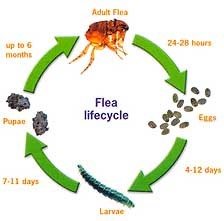
1. Fleas can hatch up to 400 eggs in 2-3 weeks.
2. The flea has four stages in their life cycle: egg, larva, pupae and adult
3. Blood is needed for a female flea to lay its eggs i.e. your pet!
So as your poor pet becomes their host, and life/blood supply, the female fleas can lay 20 eggs in one area and up to 40 eggs a day. As pets move around the home, the eggs drop from their fur and deposit into the carpets, rugs, couches and elsewhere until they are ready to hatch. This is stage one.
Depending on weather they can hatch in 2-3 days if warm and humid (yikes), and up to two weeks if the temperature is cooler.
Stage two is called the larvae stage where they have hatched and can be opaque in appearance, legless and they feed on old blood from the fleas. Eww.
Within five to 20 days these larvae get busy spinning cocoons that help them develop into an adult flea. These cocoons are sticky and designed to lodge themselves in carpet and other areas where they can continue to the next stage.
Pupae is the third stage where they transition into an adult flea. Waiting on the right conditions, they can stay in the cocoon for months until it is warm and humid, ideal conditions for hatching.
The adult flea is the fourth and final stage, and is usually triggered by vibrations, an increase of carbon dioxide and body heat. So walking around the home, children, pets and adults signals them to hatch from the cocoon.
The adult fleas are hungry and need to feed within a few hours. Pets are the common meal and fleas grow is size and shape as they feed. They also become the black colour we see commonly.
Surprisingly the adult fleas only make up just 5 percent of the flea population in the home, so the egg stage is almost 50 percent and the second and third stages make up a large portion of the active flea cycle in the home.
This makes eliminating them at the egg stage so important to having a flea free environment.
Solution:
The best way to stop the cycle is to, washing bedding, toys and clothing in warm soapy water. This gets them at the egg stage which is vital.
Pets are to be treated and washed. Foggers like Insect Grenade can be used to effectively target the eggs, larvae, pupae and adult fleas. Early morning is an ideal time to let off Insect Grenade and allow it to settle. Vacuum before and after treatment.
Flies
Flies have a more aggressive breeding cycle than fleas. They mean business. After flies mate the female fly is ready to deposit eggs. Female flies can lay 150 eggs in one go, and within less than a week, can be added up to 800 or more eggs!
 FACTS:
 FACTS:
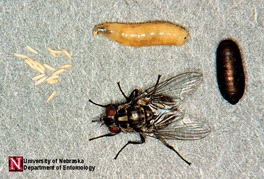
1. Flies can lay 150 eggs in a single batch. In less than a week this can add up to 800 + eggs.
2. Damp dark areas a favourable hatching spot for flies
3. It takes 7-10 days for the flies to hatch.
4. Flies generally live for about three weeks.
Stage 1: Is it rice in the fruit bowl or fly eggs? Fly eggs are hard and long in appearance much like grains of rice.
They are deposited in corners and in food, lawn clippings, compost, even drains. Eggs deposited in these places are ideal conditions for the eggs to hatch into maggots.
Stage 2: Maggots are tubular and have a single mouth to consume food and help them grow. While this sounds quite nauseating, flies are important for helping with decomposition of dead animals and other waste.
However in our homes, eateries and offices, they are not necessary and can spread diseases as well.
Maggots then malt three times before their next stage.
Stage 3: they develop into pupae which the term “pupate” is the resting period between the larvae/maggot stage into the adult fly.
Pupae appears dark and cylinder shaped, and hardens before becoming an adult fly.
Seeing blow flies coming out of the kitchen vents has to be the most bizarre example of a blow fly encounter!
Solution:
During the Spring and Summer months the Ecomist dispenser is a good solution to keeping the flies out of the home or business. Often people say they know when their dispenser is due for a new can of insect killer, because flies seem to just appear. The dispensers are recommended to be placed up high so the mist can even disperse around the room to get even coverage, set on high or medium means the spray is dispersed every 7-15 minutes.
Keep compost bin with the lid on, any stagnant water, in buckets, ponds etc…should be removed. Putting left over food in the bin, cleaning BBQ’s after use and keeping areas tidy help in the prevention of sticky flies this summer.
Mosquitos
The annoying buzzing sound in your room at night can be an indicator that mosquitos are breeding around the home and humans are the target, sometimes pets are a tasty treat as well.
The female mosquitos are the biters, day or night. 16 different mosquito varieties are found here in New Zealand, which mostly feed on birds.
The most common biting mosquitos we find in our homes and gardens are the female striped mosquito and the brown house mosquito. These non-native mosquitos lay eggs in stagnant water around homes and buildings and in pools of water in the ground.
Stage one is when the female mosquito has had a meal of blood (your family or your pet!), she is ready to lay eggs in any nutrient rich pool of water.
They then grow to the larva stage, with a head, before stage 3.
From Larvae to Pupae the mosquito develops its long breathing tube and is used to later to ‘feed’.
 FACTS:
 FACTS:
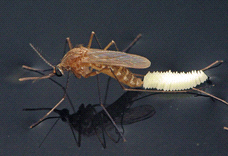
1.Up to 100 eggs are laid in oval ‘raft’ shapes which are loosely attached and can hatch within 24-30 hours.
2.The long blood-sucker or “trumpet” on the mosquito is used for breathing and developed in the Pupae stage.
3.Mosquitos are responsible for spreading human “pathogens” or viruses which can cause flu-like
illnesses and can be deadly.
4. In NZ we do not have any known disease carrying
mosquitos that affect us at this time.
Solution:
To stop the breeding cycle of Mosquitos, clear away pools of water in; tin cans, empty cans and bottles, pot plant trays, old tyres, boats, blocked drains, even outdoor fish ponds, water features and swimming pools. This can significantly cut down on the amount of mosquitos in your home or business over the Spring and Summer seasons.
Spraying a barrier spray such as Insect Sniper in cracks and crevices is another way to eliminate them at the egg and larvae stage.The E4 or Maxi Dispenser for larger rooms are ideal for targeting mosquitos in mid-air – set at high or medium this ensures you will be sure to keep pesky mosquitos away.
To prevent being a meal for the mosquitos, skin protection can be provided in an easy spray-on insecticide, like the Bug Bullit, with deet, which will be effective in avoiding the lots of itchy bites and spending time and money looking for creams and itch relief medications.
If you think you have a pest problem beyond your control, or need help with rodents contact us here
You can also see all the services we offer here: http://ecomistservices.co.nz